Take a walk, remove an invasive plant

The fields of bastard cabbage around Austin might seem too daunting to remove, but Joan Singh, Parks Grounds Manager for the Austin Parks and Recreation Department, has a suggestion. If you’re using a park like Mabel Davis anyway, take a minute to remove an invasive  plant while you’re there.

What’s important to preventing the spread of many invasive plants is to keep them from reseeding, Singh says. Bastard cabbage grows, flowers and goes to seed very quickly, producing vast numbers of tiny seeds. (See photos taken Feb. 18 and March 25 to see how fast bastard cabbage has overtaken a field next to Parker Lane.) It would be best to remove the plant, roots and all, but even just removing the flowering top of a plant can help keep the numbers down in the future.

That’s also true of another invasive plant showing up in the area, Malta star-thistle (Centaurea melitensis), says Singh. It’s easy to recognize because native yellow-flowering thistles are uncommon in this area.

Malta star-thistle is an invasive, non-native plant. Texas has no native thistles with yellow flowers, says Joan Singh with the Austin Parks and Recreation Department.

Individuals can make a difference, though a group effort to remove invasive plants from a park would be ideal. Singh says that if you give her 24 hours’ notice, she can deliver plastic bags to dispose of the plant debris. Get rid of the plants in the trash, because the seeds can spread if they make their way into recycled mulch. Leave bags near trash receptacles in the park, near a trailhead or in another logical place, and let Singh know where they are so that city crews can remove them. You can contact her at joan.singh@austintexas.gov or 974-6044.

Posted in Conservation, Garden & landscape, Parks and recreation | Tagged , | 4 Comments

Native wildflowers smothered in yellow

There’s a pretty plant blooming all over Austin, but don’t be fooled by its good looks. Underneath its veil of yellow flowers is a killer.

An invasive plant called Rapistrum rugosum (aka bastard cabbage, turnip weed or Mediterranean mustard) has taken advantage of a wild year in weather. Last year’s exceptional drought knocked back many native plants, and this year’s wet winter has allowed this invader to grow out of control, shading the ground with its large leaves and keeping the seeds of native plants from germinating. Where fields ought to be filled with bluebonnets, Indian paintbrushes and other wildflowers, this plant from Europe and North Africa has proliferated, crowding out our Texas natives.

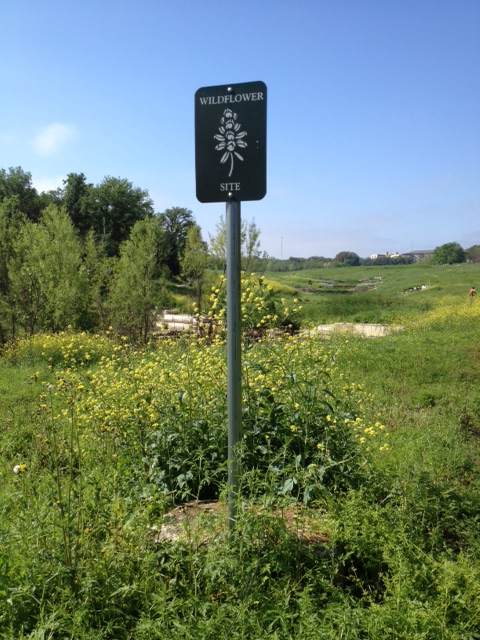
The invasive plant commonly known as bastard cabbage has overtaken the wildflower area and many more acres at Mabel Davis District Park. (Click to enlarge.)

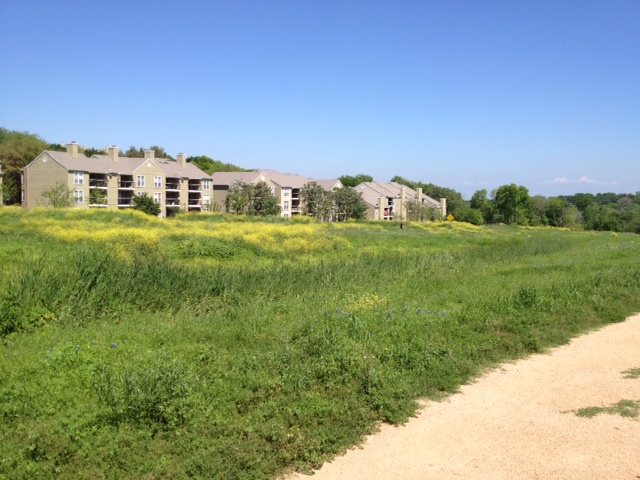
Can you find the bluebonnets in this photo? There aren't very many. That's because bastard cabbage has proliferated all along the trail in Mabel Davis Park, crowding out the native wildflowers. (Click to enlarge)

Scientists aren’t sure how bastard cabbage arrived, but they do know how to keep it from spreading: Don’t let it go to seed.

That’s easier said than done. If the plant is sprayed with herbicide but not removed, its seeds might have matured enough to keep spreading the scourge.  (It’s resistant to many herbicides, anyway. Just ask the highway departments of most of the Western states.) And there probably are already seeds in the ground, waiting for another year.

The best approach, according to Damon Waitt, is to manually remove the plant, tap root and all. Waitt, an invasive-plant specialist at the Lady Bird Johnson Wildflower Center, was interviewed by KXAN on Friday. As he told KXAN, “On a scale of 1-to-10, I’m at about 9.5 right now. If we don’t do something about this, we’re going to have to say goodbye to our Texas wildflowers, including bluebonnets.

Volunteers have been working hard to remove this plant from parks this spring. On March 24, a Boy Scout troop helped a group of Texas Master Naturalists pull up bastard cabbage by the roots at Blanco State Park. See what a big difference they made in this blog from writer and master-naturalist-in-training Sheryl Smith-Rodgers.

Learn more about bastard cabbage at this fact sheet from the Plant Conservation Alliance, a consortium of 10 federal agencies and more than 270 other organizations, including arboretums, foundations, plant societies and scientific groups.

Look for the tiny trail walker to get a sense of how expansive the invasion of bastard cabbage is in Mabel Davis Park. (Click to enlarge.)

Don’t let this plant get so much as a toe-hold on your property, and if you want to make a bigger difference, gather a group of volunteers to remove it from public lands such as  Mabel Davis Park. The long tap root will be easiest to remove when the ground is soft, within a few days after a rain. Be sure to dispose of plants in the trash.

There is hope, though. Bastard cabbage is one of the plants being researched by the Wildflower Center’s invasive species program, which has found evidence that it can be out-competed by over-sowing with the seeds of some native wildflowers, such as Indian blanket.  So do your part to keep Austin weird and wild.

Posted in Conservation, Garden & landscape, Parks and recreation | Tagged , | Leave a comment

Rains relieve drought in Southeast Austin

A wet winter has brought an end to the drought in southern Travis County, including the Burleson Heights and Burleson-Parker neighborhoods.

According to an update to the U.S. Drought Monitor this week, our area is now classified as abnormally dry, four drought stages better than the exceptional drought seen here in 2011. 

But that doesn’t mean we’re in the clear. Last year’s La Niña weather pattern is lingering in 2012, meaning that we could have another hot, dry summer. In the past, warm winters and early springs like we saw this year have indicated that a scorcher is on the way. And even though the ground is squishy, we still have a rainfall deficit of about 13 inches since the drought began in late summer 2010.

Most of the recent rains have fallen east of Interstate 35, meaning that the Highland Lakes that supply Austin’s water are still depleted. As of this morning, Lake Travis had risen more than 5 feet since Sunday, but today’s level of 638.77 feet is more than 33 feet below the historic March average. That would still rank in the four lowest levels in the lake’s history.

What you can do

In recognition of our limited water supply, Austin is still in Stage 2 water restrictions. About 70 percent of the country’s municipal water supplies are used to water landscapes, so you can make a big impact on water usage by minimizing outdoor watering.

With lawns, less is more: Turf consumes a lot of water. Reduce the amount of lawn in your landscape by installing borders and larger beds of attractive but hardy native plants. If you are putting in grass, avoid thirsty St. Augustine, and instead use native grasses such as Habiturf or improved turfgrass varieties such as zoysia. While the ground is moist and the weather is cool is a great time to plant grasses and perennials. Remember to keep the soil healthy by applying compost, and cover planting beds with at least a 3- to 4-inch layer of mulch to keep soil cool and prevent evaporation.

Collect rainwater: A rainwater harvesting system will allow you to collect water when it rains and use it on your landscape when it doesn’t. The City of Austin offers generous rebates that cover up to 50 percent of the cost of a system, from small rain barrels to large cisterns. It’s a small outlay of cash up front, and after that, you have free water for outdoor use.

Keep water on your property: Another way to make use of rainwater is to install a rain garden, a landscaped depression that captures runoff and allows water to percolate into the ground slowly. Not only do the trees and other plants on your own property benefit, but you also prevent excess runoff that can cause flooding, erosion and polluted waterways.

A little upgrade can save a lot: Inside the house, use water-conserving shower heads, faucet aerators, WaterSense toilets and front-loading washing machines to minimize how much water you consume. Find and fix leaks that can cause high water bills or can even damage your home’s foundation.

Save money while you save water: See a list of more water conservation rebates online, and read more tips for conserving water from the LCRA.

Tell us more

Want to share some conservation tips or let your neighbors know about successful water savers in our area? Submit a comment or use the Contact form to tell us about homes with water-saving landscapes and rainwater harvesting systems. With enough submissions, a future article and photos could showcase some water-wise residents and strategies.

Posted in Conservation, Garden & landscape, Travis County | Leave a comment

Brush collection begins April 2

The city will collect large brush in our area starting April 2. Have brush out by 6:30 a.m., and observe the following guidelines:

  • Stack unbound brush along the curb. The pile should be in one row no more than 4 feet high or 15 feet long.
  • Place the cut ends toward the curb.
  • If trunks are 3 to 8 inches in diameter, cut to lengths no longer than 6 feet. If trunks are more than 8 inches in diameter, cut to lengths of 3 feet or less.
  • Keep brush at least 5 feet away from your garbage cart or other obstacles, and do not place under low-hanging branches or wires. Do not let it extend into the street.
  • Do not block your mailbox or water meter, and do not lean brush against a fence or telephone connection box.
  • Crews will not pick up bamboo, vines or thorny brush.

In my experience, crews will pick up thorny brush if they don’t have to touch the thorns. Cut rose canes or other thorny brush into much smaller pieces and set them out in a plastic bin or Kraft-paper yard waste bag. Crews pick up those kinds of yard timmings on regular trash collection days, and yard trimmings and large brush are composted and turned into Dillo Dirt.

For more information, see the website for the Austin Resource Recovery department (formerly Solid Waste Services).

Posted in City projects, Garden & landscape | Leave a comment

Open house March 20 on East Riverside Corridor Master Plan

The city will hold its second open house next week to discuss housing and transportation plans for the East Riverside Corridor (ERC).

Find out how public input from the October 2011 meeting has been incorporated into plans to improve mobility and safety for pedestrians, bicyclists, drivers, and transit users (via bus and a proposed urban rail system).

The open house will be held from 4-7 p.m. March 20 at Parker Lane United Methodist Church, 2105 Parker Lane.

Read a report from the first open house in the Oct. 28, 2011, blog.

If you have questions or comments, contact Alan Hughes, Alan.Hughes@AustinTexas.gov, 974-7186. For more information, go to the East Riverside Corridor website  or the Austin Strategic Mobility Plan website.

Posted in Uncategorized | Leave a comment

Planning Commission hearing on Carlson Drive postponed to April 10

The Planning Commission hearing of Edgewick condominiums’ request to block public access to Carlson Drive has been postponed for a second time. It now is scheduled for 6 p.m. Tuesday, April 10, at the City Council chambers in City Hall, 301 W. Second St.

Citizens can sign up to speak at the hearing, or can e-mail a statement of support or opposition  to case manager Stephen Rye, stephen.rye@austintexas.com. Include your name, address and contact information, and refer to case No. C14-04-0181.SH(RCA). You also call Rye at 974-7604.

After the hearing, the case will go to City Council, which also accepts public statements.

See a Feb. 10 blog post about the request here.

Posted in City projects, Development, Meetings, Security, Transportation | Leave a comment

Off leash area at Mabel Davis Park approved

The Austin Parks and Recreation Board approved new off leash areas (OLAs) at Mabel Davis Park and Yett Creek Park at their meeting on Feb. 28.

Ordinarily when a city board or commission votes on a project, it makes a recommendation, and the issue goes to City Council for final approval. However, the director of the Parks and Recreation Department (PARD) has authority over OLAs, so the projects have now moved into the design phase.

The proposed OLA at Mabel Davis Park is part of a larger effort to create more OLAs around Austin, especially in areas near apartments where there are few places for dogs and owners to exercise and play off-leash outside. Only two of the city’s 11 OLAs are east of Interstate 35.

Neighborhood reaction

Residents of the Burleson Heights and Burleson-Parker neighborhoods are divided on the proposed OLA in Mabel Davis. Most of the 50-acre park consists of open grassland and small wooded areas, and a loop trail winds past a spring-fed pond and two forks of Country Club Creek. Amenities are limited to a small area on the west side of the park and include a skate park, a playground, a basketball court, a picnic shelter and a pool that is open only in the summer. 

Those who support the OLA tend to be dog owners or residents who want to bring more users into a park where there are few amenities, and therefore enhance security. For example, several charging stations for electric vehicles that were installed at the park in the past few months have already been vandalized.

Those who oppose the OLA tend to be people who would prefer another kind of amenity there or who cite environmental and water-quality concerns. Topping the list of environmental issues: PARD has a tight budget and relies on volunteer efforts to clean up dog waste, which has caused water contamination in other parks; the spring that forms the headwaters of the Country Club Creek watershed is about 100 feet downhill of the proposed OLA; and Mabel Davis Park sits on the site of a former landfill contaminated with heavy metals and pesticides.

Many residents on both sides of the dog park issue have said that PARD did not take adequate steps to inform area stakeholders about its plans to put in an OLA or about its subsequent meetings and hearings. Burleson-area residents were not notified about the Parks Board hearing, and the only citizen who spoke at the hearing discussed the Yett Creek Park OLA. There was no citizen or board discussion of the Mabel Davis Park OLA at the hearing.

Some area residents intend to speak at the City Council meeting at noon on March 22 to discuss their concerns about the OLA and the way this public process has been handled. Residents also can e-mail City Council members via the city website.

Park’s past limits what it can be in future

In deciding what kinds of amenities to put in Mabel Davis Park, PARD is very limited. A $10 million, 5½-year environmental cleanup of the contaminated site placed a clay cap over the old landfill, which is not allowed to be irrigated, disturbed or penetrated with fence posts or other structures. No athletic fields are allowed now.

The proposed OLA would occupy the site of a former baseball diamond that was one of the most contaminated areas discovered in the remediation project. Preliminary designs call for covering the soil in geotextile fabric sandwiched between layers of sand and mulch to keep the cap over the old landfilll from being compromised. The 1.6-acre OLA would be fenced, but no structures would penetrate the ground.

The first seven pages of the support documents from the hearing include diagrams of the proposed design and the site of the former landfill, a list of past meetings, public comments and other information.

To learn more about the park’s history, the remediation project and the proposed OLA, see this Nov. 19, 2011, blog.

Learn more at the links below:

  • Website of the Parks and Recreation Board
  • Agenda from the Feb. 28, 2012, hearing
  • Video of the Feb. 28 meeting (OLAs were discussed in Item 17, a 27-minute segment).
Posted in City projects, Meetings, Off-leash areas, Parks and recreation | Leave a comment

Panel of judges releases interim congressional map

Texas might finally be able to have a primary election on May 29 under an interim map of congressional districts that was released today by a panel of federal judges in San Antonio. Burleson Heights’ current congressional district, District 25, has been through several rounds of redistricting attempts in the past nine months.

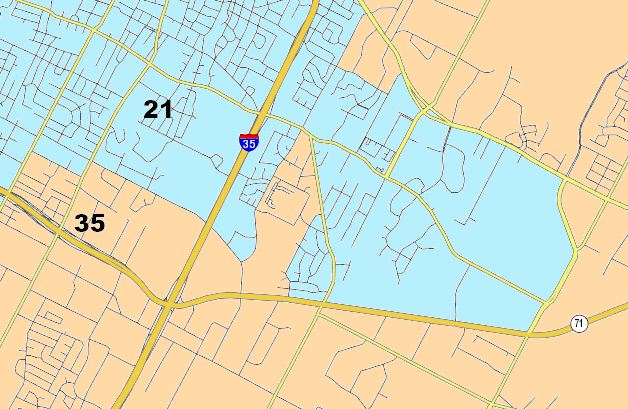
Under the interim map, Burleson Heights and most of the Burleson-Parker neighborhood are now in District 21, the district of San Antonio Republican Rep. Lamar Smith. Previously, our congressman has been Austin Democrat Rep. Lloyd Doggett.

Doggett has announced that rather than remain in District 25, he will file to run in the newly created District 35, according to the Texas Tribune. In the primary, Doggett might run against at least one candidate from San Antonio, where the district is based, according to the Statesman.

Designed to be a majority-minority district, 35 is an oddly shaped district that extends from Southeast Austin to San Antonio. But in our part of town, it is District 21 that is oddly shaped.

District 21 extends from Austin to San Antonio and out west to seven Hill Country counties. Only two small sections of District 21 extend east of I-35: in the East Riverside/Ben White area and in the Buda/Bluff Springs area. Apparently the judicial panel thinks our neighborhood has more in common with the fine people of Blanco, Fredericksburg, Kerrville, Boerne and the Lost Maples area than with our neighbors on the other side of Riverside Drive.

The new district, 35, is appropriately named because much of it is a skinny strip that hugs Interstate 35 through five counties. It widens as it nears Austin, and includes most of South Austin east of Manchaca Road, all of Montopolis and most of southeastern Travis County. But in our neighborhoods, District 35 will encompass only a small area east of Parker Lane and west of Catalina Drive and Burleson Road.

Like the redistricting map drawn by the Texas Legislature last year, this plan still splits heavily Democratic Travis County into five districts, three of which are seats held by Republicans, one of which will be vacated by Doggett, and one of which is new. The five districts extend from Austin to San Antonio, Houston, Waco and — in the case of our previous district, 25 — near Fort Worth. It is possible that Austin could end up with no Austin-based congressional representatives.

More than half of the state’s population growth in the past decade has been among Hispanics, and previous plans were challenged for diluting minority votes. The judges’ panel that redrew the district lines had proposed a plan that addressed those concerns, but also would have created a smaller Republican majority in the Texas Legislature and U.S. House. The U.S. Supreme Court overturned that plan in January, saying that the panel’s plan must more closely resemble the Legislature’s original plan. Under the current plan, our growing state will receive four new congressional seats, with two seats that offer a better opportunity for minority representation.

To see the interim map, go to the state’s district viewer.

In our neighborhoods, Parker Lane, Catalina Drive and Burleson Road are the dividing lines between districts 21 and 35. (Click to enlarge.)

Posted in Politics | 3 Comments

Planning Commission hearing on Carlson Drive postponed

The Planning Commission hearing of Edgewick condominiums’ request to block public access to CarlsonDrive  has been postponed. It now is scheduled for 6 p.m. Tuesday, March 13, at the City Council chambers in City Hall, 301 W. Second St.

Citizens can sign up to speak at the hearing, or can e-mail a statement of support or opposition  to case manager Stephen Rye, stephen.rye@austintexas.com. Include your name, address and contact information, and refer to case No. C14-04-0181.SH(RCA). You also call Rye at 974-7604.

After the hearing, the case will go to City Council, which also accepts public statements. More information will be posted here as that gets closer.

See a Feb. 10 blog post about the request here.

Posted in Development, Meetings | Leave a comment

Show parks some love by volunteering on March 3

Saturday, March 3, is It’s My Park Day, a volunteer event coordinated by the nonprofit Austin Parks Foundation.

Every spring, the event draws up to 2,000 volunteers who build trails, fix play equipment, address erosion, build gardens and more. Projects are coordinated by neighborhood groups, organizations and individuals. You can search for a project online, then register to participate.

Here are the two projects that are closest to our neighborhood.

Pleasant Valley Pocket Park cleanup: This event is being led by Malcolm Yeatts of Southeast Austin Trails and Greenways (SEATAG). Meet Malcolm and help your neighbors clear brush and clean up trash in this pocket park between Burleson Road and the cul-de-sac in the Rosemont community on Pleasant Valley Road. This project can use 20 volunteers.
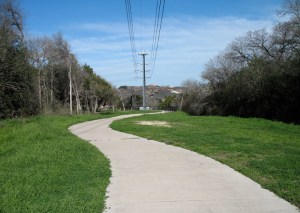
The Pleasant Valley Pocket Park has a wide sidewalk for walkers and cyclists. It runs under the power lines between the cul-de-sac on Pleasant Valley Road, in the Rosemont development, and the 3100 block of Burleson Road. (Click on any image in this blog to enlarge.)

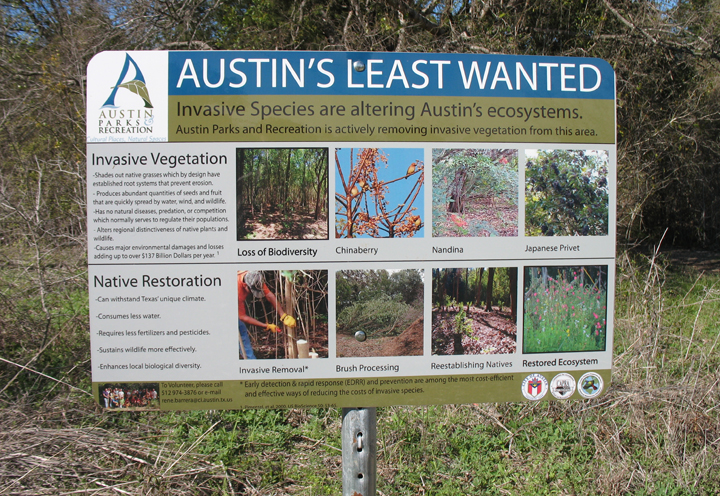
Fun in Blunn: Located between Oltorf Street and St. Edward’s Drive, next to Travis High School, Blunn Creek Nature Preserve is a wooded hilltop park that is overrun with invasive plants such as ligustrum, one of the top 3 most invasive plants in our area. Volunteers will help remove invasives, plant natives, build trails and pick up litter. This project can use 55 volunteers.

Blunn Creek Nature Preserve is a 38-acre natural area between Oltorf and St. Edward's Drive, just west of Travis High School.

Learn a new skill, then bring it home

These projects are a great way to meet people and learn skills that you can then apply in your own neighborhood — in your yard or along our creek and in our parks.

Invasive plants have crowded out desirable natives in the area, and create dense growth that provides cover for homeless camps and illegal activity.

Some invasive plants are natives, but most got their start as exotic ornamental plants sold in nurseries. With no natural enemies outside their native habitat, they spread prolifically into natural areas, choking out native plants that feed and shelter wildlife, and creating shade that kills understory plants and leads to erosion.

If you want to start small, spring is a great time: You can identify invasive seedlings such as ligustrum before other plants leaf out, and the ground is soft and wet enough that you can pull them out by the roots with your hands. For safe ways to remove larger plants, you’ll want to learn from the experienced crews in a park cleanup.

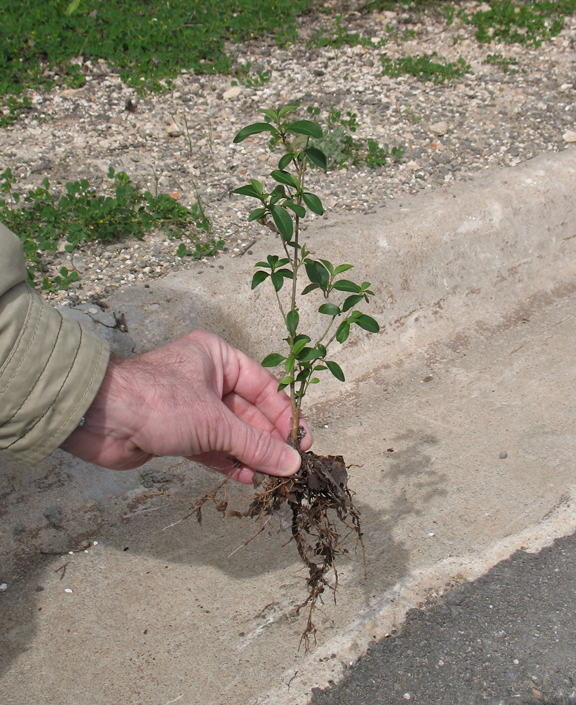
Don't let this ...

... turn into this! Ligustrum, also known as Japanese privet, grows so densely that it chokes out native plants, leading to bare soil and erosion problems. This dense stand near Country Club Creek is about 10 feet high, but the plant can grow about two feet a year until it becomes a 25-foot tree.

To learn why Austin Parks Foundation removes invasive plants, read their Ecological Restoration website. Find out how to identify invasive plants in the Austin area with the Grow Green program’s Invasive Plants pdf.

And for heaven’s sake, don’t plant any more invasives! Many reputable nurseries refuse to sell invasive plants, but you can still find them at chain nurseries and big box stores. Instead of planting something like ligustrum, photinia or Japanese honeysuckle that will grow and spread out of control, opt for one of the many hardy, non-invasive natives that will give you the same attractive features. Wildlife and future park volunteers will thank you.

Signs educate hikers about invasive plants in Blunn Creek Nature Preserve.

Posted in Garden & landscape, Parks and recreation | Tagged , , , | Leave a comment