Stripes are in vogue on Parker Lane

Austin’s Bike Route 59 got new lane markings in the 0.6-mile section at the south end of Parker Lane on Thursday.

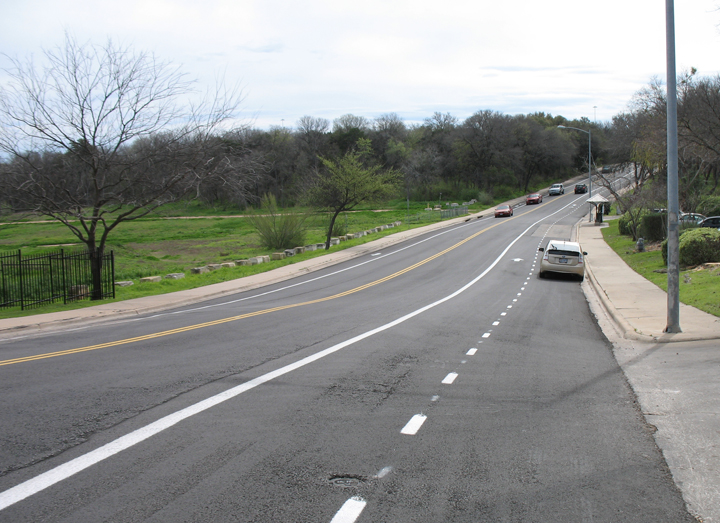
New stripes mark the boundaries of two bicycle lanes, one parallel-parking lane on the west side of the road, and two lanes for cars, plus a turn lane near Woodward Street.

Parallel parking is not allowed in the bike lanes. New no-parking signs have been installed where parallel parking is prohibited: On the east side of Parker from Woodward Street to Royal Hill, and on the west side of Parker for 400 feet north of Woodward.

The new lanes at the south end of Parker Lane include one lane for parallel parking, plus two bike lanes and two lanes for cars. To the left is the 50-acre Mabel Davis Park. (Click to enlarge)

The striping is part of a city mobility project to address traffic congestion and air quality issues, and was announced here in a Jan. 22 blog post. Parker Lane and Burleson Road are frequently used by bicycle commuters and recreational cyclists as routes to downtown Austin, St. Edward’s University, Mabel Davis Park, the Lady Bird Lake hike-and-bike trail and other sites. The area is also a short ride from McKinney Falls State Park via Burleson’s bike lanes.

Parker Lane’s new stripes end at Royal Hill Drive, only two duplex lots away from Carlson Drive, which has become an important east-west route for cylists, pedestrians, drivers, transit users, school buses and emergency vehicles in the area. See a Feb. 10 blog post about how Edgewick condominium developers and homeowners are requesting city permission to block public access to Carlson. Cyclists have been notified about the development’s plans in the e-newsletter of the Austin Cycling Association, and the League of Bicycling Voters has said that it opposes closing Carlson.

Posted in City projects, Parks and recreation, Safety, Transportation, Uncategorized | Tagged , , | Leave a comment

City plans to restore Norwood House, shrink dog park

The City of Austin is planning to restore the historic Norwood House at the corner of Riverside Drive and Interstate 35, according to a Feb. 15 story in the Austin American-Statesman.

The property is seen as a gateway to the city for downtown visitors and airport users. It is also near the sites of a boardwalk planned for Lady Bird Lake  and a proposed urban rail line.

Restoring the house and building a rental center for events will require the existing dog park to shrink from 1.9 acres to 0.5 acre, according to the story, but the dog park would get improvements such as benches and fencing.

Money for the restoration, which could cost up to $7.6 million, will likely come from private donations, the nonprofit Austin Parks Foundation and the public. The project might be included in a November bond election, according to the Statesman story.

The house belonged to Ollie Norwood, the developer behind Austin’s first skyscaper, an elaborate Gothic Revival building known as the Norwood Tower (1929). The 16-story tower was the city’s tallest commercial building for almost 40 years, and in that time was surpassed only by the 310-foot-tall Texas Capitol and the 307-foot-tall UT Tower.

See a seven-minute video segment about Norwood Tower, where the penthouse is the home of former first daughter Luci Baines Johnson, on the KLRU series “Downtown.” See current and historic photos of the Norwood House in a blog posted here on Oct. 15, 2011.

Posted in City projects, History, Media, Parks and recreation, Taxes | Tagged , | Leave a comment

Edgewick development wants to gate important east-west road

The developers and residents of Edgewick condominiums are asking the city for permission to gate off Carlson Drive.

The Austin Planning Commission will hear Edgewick’s request at 6 p.m. Feb. 28, in the City Council chambers at City Hall, 301 W. Second Street (see the Feb. 28 agenda online). The request will go before the City Council at 2 p.m. March 8. However, the city has already postponed the commission hearing once in order to have more time to review the case; it might postpone the City Council hearing, too.

South of Oltorf, Carlson is one of only three streets connecting to the east side of Parker Lane. Of the remaining two, Wickshire is one-way, westbound. (Click map to enlarge.) Map data from Google.

This is a hilly area filled with creeks, springs and large tracts of public property, and it was not developed with adequate connecting streets by early planners. Nearby streets twist around old property lines and natural features.

Carlson Drive is one of only three east-west roads south of East Oltorf Street that connect with the east side of  Parker Lane. Of the three, it is the safest for walking, cycling or driving because it has a traffic circle to keep speeds down, is level, is wide, has few intersections, and has parallel parking on one side only.

Carlson runs along the northern edge of Edgewick condominiums. Image from Google Street View.

Only two other neighborhood roads provide access to the east side of Parker in the 1.3-mile stretch between East Oltorf and Ben White Boulevard/Texas 71:

Wickshire Lane is at the midpoint between Ben White and East Oltorf. It has a single one-way lane on its eastern half, where it has no curb or sidewalk; it has a 90-degree turn at the bottom of a steep hill; and it has no guardrail at that curve. Before Carlson was built, drivers often illegally drove east on the westbound road because of the lack of alternatives – not a safe situation on the border between Linder Elementary School and Mabel Davis Park.

Wickshire is one-way, westbound. Cars that illegally drive downhill run the risk of overshooting the 90-degree turn and ending up in a ravine or pond.

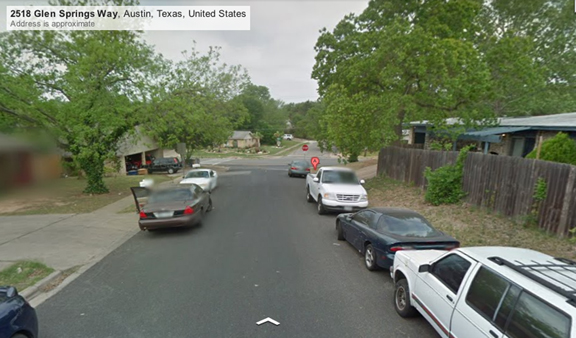
Glen Springs Way is a tiny residential street. Just 0.2 mile south of Oltorf and 0.1 mile long before it ends at Metcalfe Road, it is too far north to provide adequate access to most homes in the area. It was not designed to be a thoroughfare: This short stretch of road is the sole access to at least 34 residences. If Carlson Drive is closed, Glen Springs will be the only neighborhood street providing eastbound access from Parker Lane.

In just a tenth of a mile, Glen Springs Way has 11 driveways, two cross streets and dozens of parallel-parked cars. Image from Google Street View.

Carlson was designed to safer specifications than Wickshire or Glen Springs, and is the best road in the area for east-west travel. Image from Google Street View.

What is the problem, and is closing road really the solution?

A portion of Carlson Drive had existed at Parker Lane for decades. Edgewick, which does business under the name Shire’s Court, bought the adjacent land in 2005 to build condominiums. The developer for the project is Benchmark Development Inc., which also is the developer for the Austonian luxury high-rise,  other Austin urban infill neighborhoods similar to Edgewick, and Plum Creek neighborhood in Kyle.

In October 2006, Benchmark executive David Mahn, listed as president of Shire’s Court, signed an agreement granting the city a “perpetual” easement on Carlson for “free and uninterrupted pedestrian and vehicular ingress and egress,” for water, wastewater and drainage utilities, and for solid waste services and emergency vehicles, “forever.” Shire’s Court then built the remainder of Carlson and connected it with Metcalfe Road. Technically, that portion of the street is Shire’s Court’s property, and it is maintained by the homeowners association.

Management at Edgewick now wants to deny public access to Carlson. It claims in its request for an amendment to the restrictive covenant that residents have had problems with crime and vandalism, including dog theft, breaking and entering, speeding, tagging, broken windows and damage to amenities. (Follow link, then see attachments. The request is on page 11 of the attachment labeled Part 2.)

The management says in its request that the problems are originating from the public who use Carlson Drive. Its also claims in its request that the road “splits” the development and “invites people outside the community to enter at any time.” However, all residences in Edgewick are south of Carlson, and all are separated from the road and sidewalk by a fence. No outsiders can enter Edgewick from Carlson without being allowed through a gate.

A search of the city’s Crime Viewer website finds only two police reports involving residential property crime in Edgewick in the past 12 months. Reports in 2011 include two auto burglaries on Carlson, one fraud and one burglary of a construction site.

In the previous 12-month period, there were nine reports of property crimes affecting residents — five criminal mischief incidents (one incident affected two addresses), three home burglaries and one theft — plus one abandoned vehicle and one harassment case. All but two occurred in 2010 during the summer and December, peak months for crime throughout Austin. Homes were only a year or two old at the time, and Edgewick was largely a construction zone, with few residents to keep watch for their neighbors.

Edgewick says in its request to the city that it has added security cameras, a daily security service and security tips in the neighborhood newsletter. The drops in property crime affecting residents (77 percent drop from 2010 to 2011, and 100 percent drop from October 2011 to the date of this posting) suggest those efforts are working. The last home burglary report was 15 months ago.

There is little evidence that Edgewick residents are dealing with more difficulty than their neighbors are on the other side of the fence, and the low number of police reports in the past year and a half suggest there might be fewer crimes there. If people are entering Edgewick from Carlson to commit crimes, they are trespassing by crossing a fence or a gate. A good first step for management would be to address gates left open day and night, gaps in fences and other entry points visible all around the property.

Gating Carlson would be unlikely to keep criminals out, but it would keep law-abiding neighbors from helping to watch for illegal activity.
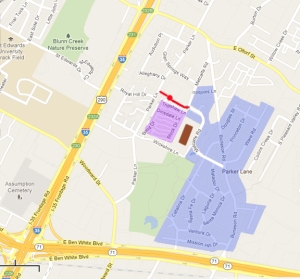
Edgewick (condo development, purple) has 60 owner-occupied residences, and wants to close Carlson Drive (red) to the public. For hundreds of households in Burleson Heights and Burleson-Parker (blue), Carlson is one of the only neighborhood streets providing access to Parker Lane, St. Edward's University, the IRS complex and other sites. It also is a main road serving Linder Elementary (brown), the most crowded elementary school in Austin. (Click map to enlarge.) Map data from Google.

Who uses Carlson?

Carlson Drive provides access to schools, a public park, public transportation, homes and businesses for thousands of area residents.

Carlson has been identified as a Safe Route to School by the City of Austin Neighborhood Connectivity Division. It is used by Linder Elementary parents and students, and is on the bus route for the Ann Richards School for Young Women Leaders, a college preparatory public school. Transit users rely on Carlson as one of the only paths to and from Cap Metro buses on Parker Lane, because there is no longer a bus route on Burleson Road. Cyclists use Carlson because it is the only level, uncongested road in the neighborhood that connects with Austin Bike Route 59, which soon will get new striped bike lanes on Parker Lane — less than a block from Carlson — as part of a city mobility project.

Access is also necessary for emergency vehicles. If Carlson were closed, a fire truck or police car coming from the south or west would have to travel almost half a mile out of its way via Glen Springs before continuing to its destination east of Edgewick.

Those are some of the reasons that the City of Austin puts such great emphasis on connectivity between neighborhoods. Carlson Drive is a route that was needed in the area for decades, and it was represented on maps long before it was connected with Metcalfe. It’s too late to turn back the clock. This is a part of town that is densely populated now, and it is expected to grow even more because of its proximity to downtown, a university, major roads and a planned urban rail system.

Here’s my blatant editorializing: It doesn’t matter how affluent, educated or isolated you are — anyone who lives in the inner city has to cope with certain issues, even in million-dollar neighborhoods like Travis Heights, Hyde Park and Tarrytown. Neighborhoods around Edgewick don’t deal with crime or vandalism by walling themselves off. Instead, they have Neighborhood Watch programs, group cleanups, frequent contact with city officials, park projects that provide activities for bored teens, and other efforts to improve the quality of life for all residents.

Many neighbors are happy to see a new, attractive development that draws more professionals into our community. We would welcome Edgewick residents in our neighborhood groups and activities. We think openness is a solution that would benefit us all.

Blocking a street used by thousands of people is shortsighted, and sacrifices the needs of the many for the fears of a few.

What you can do

For the Austin Planning Commission hearing on Feb. 28, Edgewick has given the commission statements from all of its property owners asking for the road to be closed to the public. As a member of the public, you have the right to request that your statement be included in the file attachments for this case.

The city is in a difficult position, says Stephen Rye, the city’s case manager for the Carlson Drive request: Carlson is a private road with a public easement granted to the city, and support for taking away the easement is unanimous within the community that owns it. However, the city sees the road’s importance to connectivity for public users. City staff, the Planning Commission and City Council will look at statements from all sides in making their decisions.

If you cannot attend the Planning Commission meeting, you can e-mail a statement to Rye at stephen.rye@austintexas.gov. Refer to case No. C14-04-0181.SH(RCA). You can also contact Rye at 974-7604.

Homeowners and other Carlson users can also involve organizations that see the importance of connectivity in this area. Already, the Austin Bicycle and Pedestrian Program and the League of Bicycling Voters have made statements that they oppose closing Carlson to the public, and the Austin Cycling Association told members about the possible closure in its e-newsletter. This is the time to alert the Austin Police Department, Austin Fire Department, AISD schools and bus services, parent-teacher groups and other public and private stakeholders.

Stay tuned for more news on this issue.

Posted in Development, Meetings, Safety, Security, Transportation, Uncategorized | 3 Comments

Branding boosts neighborhood’s trendiness

Betcha didn’t know that the neighborhood immediately north of us has a trendy name: South Shore.

Bounded by I-35, Lady Bird Lake, Pleasant Valley Road and Oltorf Street, the area gets a profile in the Hidden Neighborhoods series in the Statesman Homes section.

Those of us who live here have always known about the area’s assets: We have bungalows and ranches, big yards, big trees and a short commute to downtown, the city’s universities and the airport — and all for just a third to half of the price for the same kinds of homes west of the interstate in Travis Heights and St. Edwards’ neighborhoods.

The Statesman article refers to redevelopment of the Riverside/Lakeshore area as bringing new restaurants, new residents and new activities to the area. Businesses in some new mixed-use developments (apartments and condos with ground-floor retail spaces) are starting to cater to young, active residents drawn to parkland along the river.

Real estate broker Ford Shanley is quoted as saying that the neighborhood offers value for renters and buyers who want to live there or invest there before prices rise, an anticipated effect of the redevelopment.

Who knows how far south that lift in prices (and, most likely, property taxes) will go. But I’m glad to see our area get attention in the news for its positives. And after many SE Austin residents have been crying for renewal and city services for so long, it’s nice to see some bike lanes, sidewalks and parkland starting to enhance what has been a desirable but overlooked inner-city neighborhood.

It was only a matter of time before this “hidden neighborhood” was discovered. A higher profile could help us when we ask for the things we still need.

Posted in Development, Media, Taxes | Leave a comment

Striped bike lanes will be added to more of Parker Lane

The City of Austin plans to add striped bike lanes to a 0.6-mile stretch at the southern end of Parker Lane.

Already part of Bike Route 59 in Austin, Parker Lane only has clearly striped bike lanes north of Oltorf Street and in a one-block section south of Oltorf, between Rockbridge Terrace and Glen Springs Way. Under the city’s plan, the new bike lane markings will start at Woodward Street on the south end and and will extend north to Royal Hill Drive.

Parker is wide enough to accommodate two lanes of traffic, two bike lanes and one lane of parallel-parking, so the new markings will include one parking lane on the west side of Parker. Parallel parking will no longer be allowed on the east side of Parker between Woodward and Royal Hill.

The city’s Public Works and Transportation departments will hold an open house to discuss the plan and get community feedback from 6-7 p.m. Jan. 24 in the eighth-floor conference room at One Texas Center, 505 Barton Springs Road.

Read more about the project in an announcement here. See a PDF of the city’s designated bicycle routes (a very large file), and keep up with bicycle-related projects at the city’s website. If you aren’t able to attend the meeting but want to provide feedback, contact city liaison Neil Kopper at 974-7166 or neil.kopper@austintexas.gov.

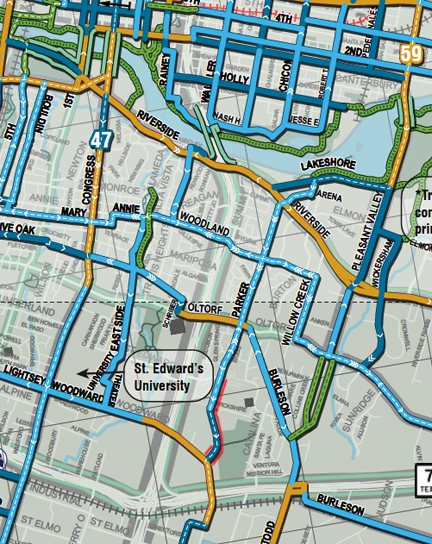
Parker Lane is part of Bike Route 59 in Austin. The new bike lanes and parking changes will be at the south end of Parker. Areas highlighted in red show where parallel parking will no longer be permitted; click image to enlarge. (Detail from the City of Austin bicycle map.)

Posted in City projects, Transportation | Tagged , , | Leave a comment

Pocket park could take place of former Parker Lane mansion

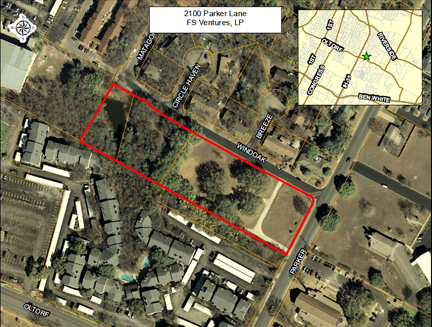
At its Dec. 15, 2011, meeting, Austin City Council approved the purchase of 3.53 acres in Southeast Austin for a future pocket park. The property at 2100 Parker Lane is on the corner of Parker and Windoak Drive, and is shaded by three heritage oak trees. Council recommended the purchase because it could provide a gathering place for residents and visitors at nearby homes, apartments and churches in an area that some consider to be underserved by parks.

The lot is at the corner of Parker Lane and Windoak Drive. (Photo from the City of Austin, http://www.ci.austin.tx.us/edims/document.cfm?id=161771)

The city defines a pocket park as a small area, generally less than two acres, that “offers green space in a location where public green space is limited or not served by any other park. … Pocket parks are incorporated into existing dense residential areas to meet the demand for public green space.”

But the property hasn’t always been open space. In 1963 Austin builder Jack Andrewartha built his home there. With its custom woodwork, cork flooring, Waterford crystal sconces and Italian marble foyer, his 4,500-square-foot Colonial Revival mansion was recognized in a cover story in the National Association of Home Builders’ magazine in 1965, according to an article in the Austin American-Statesman on May 29, 2004. At the time of the Statesman article, the renovated estate featured a guest house, a pool and a spring-fed pond and was on the market for $899,000.

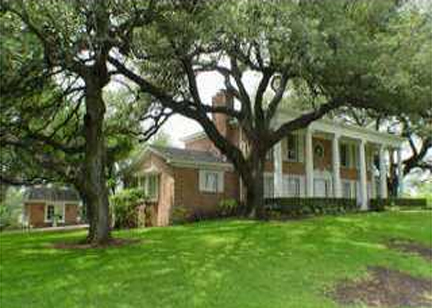
The 4,500-square-foot Colonial Revival mansion at 2100 Parker Lane was featured on the cover of a national builders' magazine in 1965. For more photos, sales prices and information about the times the house has been on the market, see Robert Griffice's comment on this post or go to http://bit.ly/2100ParkerMLS. (Photo from Multiple Listing Service.)

The sellers, who were the estate’s second owners, were approached by several would-be buyers, many of whom wanted to turn the house into a bed-and-breakfast. According to a followup story in the Statesman on July 17, 2005, the owners wanted it to go to someone who would love it as much as they did, and sold it to a buyer who said that he planned to make it his family home. But not long after it sold, it was back on the market.

Times were changing in Austin, and 3.5 acres near downtown attracted developer Michael Hamilton of Servant Builders. In July 2005, just three months after the house sold to its third owner, Hamilton bought the property with the intention of building condominiums. Despite the objections of neighbors, the mansion was torn down, and the land was approved for as much as 20 0r more residential units.

However, the economic downturn prevented the development of the property, and it again went back on the market — it has been for sale for much of the past eight years. Throughout the process, nearby neighborhood association the South River City Citizens has been following along, posting updates on its website and attending city meetings that included discussions of development plans and the possible park.

Though a neighborhood landmark has been lost, the property itself is still beautiful and could become available to all residents in the area to use. Learn more about the city’s approval of the land purchase at the Dec. 15, 2011, City Council meeting here.

As late as December 2011, websites touting the real estate listing for 2100 Parker Lane promoted the large oak trees on the property. Those trees were among the top reasons cited by the city for the land's desirability as a park. (From http://www.2100parkerlane.com)

Posted in City projects, History, Parks and recreation | Tagged | 1 Comment

Proposed dog park at Mabel Davis Park

The Austin Parks and Recreation Department (PARD) held a meeting Nov. 7 about an off-leash area that has been proposed for Mabel Davis District Park. This was a follow-up to a meeting held June 27 at Linder Elementary.

There were no spoken presentations at the November meeting, but several posters gave information on the proposed park, and city staff and Bill Fraser, chairman of the Off-Leash Area Advisory Committee (OLAAC), were there to answer questions.

The presentations are available online. A PDF shows an aerial photo of the south end of the park, including the pond where a spring forms the headwaters of Country Club Creek, which is adjacent to the planned off-leash area. It also shows similar off-leash areas in other cities, the city’s rationale for wanting to put a dog park at Mabel Davis, and some community concerns that were expressed at the previous meeting.

You also can see what people wrote on comment cards at the Nov. 7 meeting. Some residents support an off-leash area, while others have concerns about its safety, maintenance and environmental impact.

Off-leash area background: The city has 11 OLAs in Austin, two of them east of I-35. Parks and Recreation wants to add more OLAs, especially in areas near apartments.

A 1.6-acre off-leash area (OLA) is proposed for the site of the former baseball diamond at Mabel Davis, just south of the swimming pool. The uses of that land are limited because it is the site of a contaminated former landfill.

PARD has proposed a design that avoids penetrating a protective clay cap over the landfill by covering the ground with 2 inches of sand, a brightly colored geotextile fabric, and a 12-inch layer of mulch. The fence around the OLA would be anchored in a ribbon of concrete that would sit on the current grade and would not penetrate the soil. The theory is that activity would uncover the geotextile fabric, signaling staff or volunteers to add more mulch, before the soil can erode.

However, the city does not have the staff or the budget to maintain all its parks, so it encourages individuals or groups to adopt parks. Volunteers in the Adopt-a-Park program help with enforcement, maintenance and other activities. The Watershed Protection department also has a Scoop the Poop program to encourage people to clean up pet waste and prevent water contamination. The nonprofit Austin Parks Foundation also helps maintain city parks.

Mabel Davis Park background: The City of Austin bought 50 acres to create the park in 1974. Originally a gravel pit, the area operated as St. Edward’s Municipal Waste Landfill from 1944-1955. But even after the landfill closed, it was illegally used as a dumping site, including for toxic materials such as pesticides and lead battery casings.

The contamination was discovered in 1999, and the park was closed for a 5½-year, $10 million remediation project. An 18-inch clay cap over the former landfill is covered with soil to form a layer 30 inches deep.  The worst contamination was at the site of the former baseball diamond, but a sports field and many other activities are no longer allowed at that site, because irrigation or erosion of the clay cap could cause more contamination. (For more information on the remediation, see pages 3-5 of a publication from the U.S. Conference of Mayors.)

Contacts: Learn more about the Parks and Recreation Department’s off-leash areas online. The city liaisons are park planner Ricardo Soliz (974-9452) and landscape architect D’Anne Williams (974-9456). You also can e-mail comments to MabelDavisParkOffLeashArea@ci.austin.tx.us.

Posted in City projects, Meetings, Off-leash areas, Parks and recreation | Tagged , , | 3 Comments

Storm drain work on Ware Road

The large Public Works project that started in Burleson Heights in 2010 is almost over. Though our streets have been quiet again for months, the City of Austin has one last phase to complete before it can call the project done.

One last section of storm drain will be installed at the north end of Ware Road, allowing water that’s collected in the new storm sewer system to drain directly into Country Club Creek. Weather permitting, workers will start installing 78 feet of pipe on Tuesday. Work should be completed on Wednesday, the day before Thanksgiving.

The city has been working for more than a year to obtain an easement between Ware and the creek. That property was owned by the company that owns Douglas Landing apartments, on the opposite side of the creek.

For more information about the storm drain and the creek stabilization project, see the blog posts from Aug. 10, 2011.

You also can contact the city’s project manager, Rick Colbrunn of the Public Works Department:
rick.colbrunn@austintexas.gov
974-7089

Posted in City projects | Tagged | Leave a comment

City’s plan for East Riverside Corridor

The City of Austin held an open house Oct. 27 at Travis High School to invite input on its East Riverside Corridor (ERC) Master Plan and Draft Regulating Plan. The regulating plan will translate the recommendations of the master plan (adopted by City Council in 2010) into design regulations so that future developments conform with the city’s desires for a mixed-use corridor. For a basic introduction to the master plan, read the city’s FAQs. You can find the recommendations for the entire plan online at the city’s East Riverside Corridor Plan website.

The city also is launching a transportation study of the 3.5-mile corridor from I-35 to Texas 71 (Ben White Blvd.). The study is designed to identify improvements that would aid the mobility and safety of drivers, bicyclists and pedestrians. Riverside also will get an overpass at Texas 71, which will be built as the freeway is extended to U.S. 183 starting in January.

The goal of the master plan is to transform the ERC from an area dominated by cars and parking lots into one with mixed residential and business developments that is more functional, vibrant, comfortable, safe and beautiful for residents, workers, commuters and pedestrians. It focuses on providing alternative forms of transportation, such as bike paths and urban rail, and providing housing for a range of incomes.

Plans also dictate that Riverside include wide sidewalks; shade from trees, awnings and pergolas; open space, plazas and pocket parks; and bike lanes (on the street) or bike paths (dedicated bike facilities outside the area used by automobiles, similar to a wide sidewalk). Business and residential driveways would be planned for side streets, rather than Riverside, to improve safety. New streets or paths are proposed to provide better connectivity in the area without putting more of a strain on Riverside Drive. (Our neighborhood is not in the ERC boundaries, and no new streets are proposed near us.)

You can watch the video ‘How the Dutch Got Their Cycle Paths’ to see one possible way to design bike facilities in the East Riverside area.

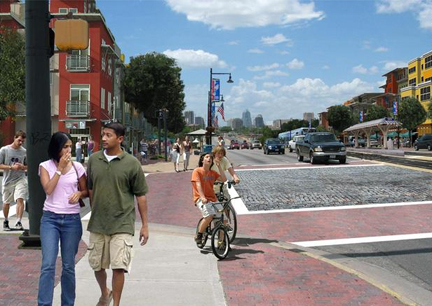
A rendering from the City of Austin represents how East Riverside Drive might look with a mix of businesses and residences in low-rise buildings with wide, shaded sidewalks, bike paths and other improvements.

The ERC Master Plan also incorporates plans for an urban rail system being considered by the city. The system would provide trains powered by overhead electric wires and would run from Austin-Bergstrom International Airport to downtown Austin, the UT campus and the Mueller development. Urban rail is likely to go before voters in a fall 2012 bond election. If approved, portions of the system could be running by 2015. Learn more at the Austin Strategic Mobility Plan.

Under the master plan, future development is concentrated around four ‘hubs’ of East Riverside, tied to the location of four future urban rail stops. The densest development would be near rail stops, and building heights would vary with density — from up to three stories in areas bordering neighborhoods to up to five stories in mixed-use areas along the corridor.  A large rail stop/transportation hub would be likely in the broad median at the intersection of East Riverside Drive and Pleasant Valley Road.

At the open house,  citizens were able to review plans and maps, talk with city employees and consultants, and write comments on aerial photographs, maps and comment cards. Information stations provided details on how the plan will deal with cars, pedestrians/bikes, mass transit (including urban rail), affordable housing, design standards and zoning and neighborhood plan amendments. (Within the boundaries of the East Riverside Corridor, the master plan and regulating plan would replace the East Riverside/Oltorf Combined Neighborhood Plan, which includes our neighborhood and was adopted in 2006, and the Montopolis Neighborhood Plan. Those plans would stay in place outside the ERC boundaries. See documents for the city’s neighborhood plans here.)

A display on affordable housing had some interesting statistics:

  • Subsidized housing in the ERC currently accounts for 23% of all existing housing within the corridor boundaries and 11% of the subsidized housing citywide.
  • Market-rate housing (not subsidized, just cheap) in the ERC that is affordable to people earning 50% or below of the Median Family Income accounts for 6% of the total market-rate affordable housing citywide. (Housing is considered affordable if the combined cost of rent and utilities uses no more than 30% of residents’ income.)

Land values already have risen in the area, and future development is likely to bring more affluent residents. The plan intends for the area to provide a mix of housing options for a range of incomes, including low and middle incomes.

Some nearby residents say the plan needs more owner-occupied housing, more single-family housing and a broader mix of developments. And some are frustrated that they collaborated on the Riverside/Oltorf neighborhood plan, only to have it replaced by the ERC plan in the Riverside area. To learn more about the plan and see how some neighborhood groups are responding, read a story that ran in the Austin-American Statesman on Oct. 27.

Public hearings before the Planning Commission and City Council are anticipated in the winter/spring of 2012. The regulating plan could be adopted by spring of 2012, before the city holds a bond election on urban rail.

Want to comment on the plan? Contact senior planner Erica Leak,  erica.leak@austintexas.gov, (512) 974-2856, City of Austin Planning and Development Review Dept., P.O. Box 1088, Austin, TX 78767. You can sign up to receive updates from the city by going to the bottom of the plan’s website and clicking the link under ‘Get involved/Contact.’

What do you think of the ERC Master Plan? You can express your views here using the ‘Leave a comment’ link below.

Posted in City projects, Safety, Transportation | Tagged | Leave a comment

City proposes plan to deal with invasive plants

The City of Austin is proposing a plan to manage invasive plants on city-owned property such as parks and easements. If passed, it will  be the first such management program in Texas and the second in the U.S.

The plan would identify the economic and ecological impact of invasive species and find solutions that could be implemented citywide. It is being developed by UT’s Lady Bird Johnson Wildflower Center.

Invasive non-native plants spread quickly, compete with native species and disrupt the local ecosystem, such as by choking waterways and crowding out plants that provide habitat and food for animals. Plants identified as invasive in the plan include Chinaberry, ligustrum (Japanese privet), elephant ear, Japanese honeysuckle, Chinese pistache, pyracantha, hydrilla and water hyacinth.

The city wants to remove these plants from its property, and you can do your part by not buying them at garden centers or planting them in your landscape. (I’m guilty of owning a Chinese pistache, which was encouraged in our area and planted widely by the city before it was discovered to reseed readily and become invasive in natural areas.)

View the proposed plan online at www.wildflower.org/docs_coa/.

Public meetings will be held from 7 to 8:30 p.m. Nov. 1 and 3 at One Texas Center, 505 Barton Springs Road, Room 325. If you can’t attend a meeting, you still can comment on the proposed plan online.

Posted in City projects, Garden & landscape, Meetings | Leave a comment